Mango and LimeMy autumn crop includes mangos, from a tree that is now nearly twenty years old. It is not a big tree mainly because it is into its second life - in 2001 a bushfire burnt the tree so badly that I thought it was dead and cut it off to a stump, but before I could get round to digging out the stump a new shoot emerged which has grown into a small tree and four years ago produced its first fruit. The biggest crop ever this year at 17. Because of the cool weather, I assume, the fruit does not ripen until April, though along with a lot of other fruit the mangos are starting to ripen in late March. They are a very welcome touch of the tropics and the taste takes me back to my youth in Queensland. The taste of tree ripened mangos is so ripe and luscious that you realise why this fruit has such a reputation, a reputation that is never reached by the fruit picked early transported and sold in the fruit shops of the southern states. I eat all the fruit from my trees fresh, on a very few occasions with prawns in a salad, but mostly just as is for breakfast.
Another warm climate fruit I grow is the Tahitian lime, these are also ready now, in fact starting to turn yellow as they get to the end of their ripening life....a gin and tonic is not the same without a slice of lime.
Apples
The Granny Smith apples are ready to be picked and stored, they will store in cold conditions for a all of winter, giving me time to deal with the golden delicious. Granny Smith is good for both eating fresh and cooking. The last of my apple trees is the Lady Williams its crop will not be ready until late May.
Max Dingle 27 March 2014
http://www.maxdingleart.com/max-blog.html
Showing posts with label max. Show all posts
Friday, March 28, 2014
Sunday, March 23, 2014
Autumn is here
Golden Delicious Apples and Persimmons
Autumn is here when I, and the parrots, get the first persimmons. The parrots, I must admit, start eating well before my Fuji fruit are fully ripe but they provide an early warning system, time to bag and net off the fruit I want, leaving a share for them. They are however starting to get rather sneaky and trying to get their head inside the bags or crawl in through gaps in the netting. The apples were bagged quite a while ago well before they even started to ripen, in order to save them from fruit fly and from the birds.The Fuji persimmons can be eaten while still firm like an apple and used in salads. Greens, finger lime caviar, macadamia nuts, peeled persimmon cut in chunks, olive oil , freshly ground pepper, fresh goat curd or feta or parmesan (NB while I peel the fruit, it is not really necessary, just wash and use.) Can also serve slices with the cheese course. I prefer however to leave the fruit until it is very soft and then spoon out the pulp to have as is, or every so often with clotted cream, ice cream or mascarpone. The pulp can also be used in cakes or puddings but the cooking seems to remove all taste of persimmon, although does affect the texture.
Golden Delicious apples are best fresh i e not stored for too long. They are wonderful cooked and seem to hold their shape fairly well rather than collapsing into mush. I eat fresh and cooked in all sorts of ways, especially in salads, apple pies, tarte tatin and cakes.
Max Dingle 23 March 2014
http://www.maxdingleart.com/max-blog.html
Friday, March 21, 2014
Gastronomic Symposiums
Jacks and Jaggers
The Leeds Symposium on Food History and Traditions has been announced for 17 May 2014 at Friends Meeting House, Friargate, York, UK. The subject is kitchen technology from 1600 to the second world war - hence the Jacks and Jaggers title. For more information check out their website www.leedsfoodsymposium.org.uk
Food and Markets
Apart from examining historical, sociological and practical aspects of food markets this symposium will not forget the pleasures of marketing: the excitement of discovering new ingredients; watching the skills of market cooks preparing to order and the sheer enjoyment to be found in the peace, charm and sunshine of wandering around an open-air market. Details of the 11 to 13 July 2014 symposium to be held at St Catherine's College, Oxford, UK can be found online at www.oxfordsymposium.org.uk
Muzeum Gastronomie
If you go to the above you can also check out this museum of cooking history.
http://www.muzeumgastronomie.cz You'll find it in Prague. Jakubska 12, 110 00 Praha 1 - Stare Mesto.
Max Dingle 21 March 2014
http://www.maxdingleart.com/max-blog.html
Sunday, March 16, 2014
Blue Dog Country Cafe - Update
The Blue Dog Country Café is a very plain looking café in a line of shops in a cul de sac just off the Princes Highway in Wandandian, If you are looking for the latest designer décor this is not the place for you, unless you think bare brick walls, a mix of tables and chairs are the latest fashion, and judging by the décor in some of Sydney's new small bars, this may well be the case. What-ever...........
However since writing about this cafe in 2014 ownership has changed hands. The 2018 version is a stop for the hungry traveller who wants nothing 'fancy', just budget prices.
Max Dingle 2018
http://www.maxdingleart.com/max-blog.html
Wednesday, March 5, 2014
Harvesting and Eating
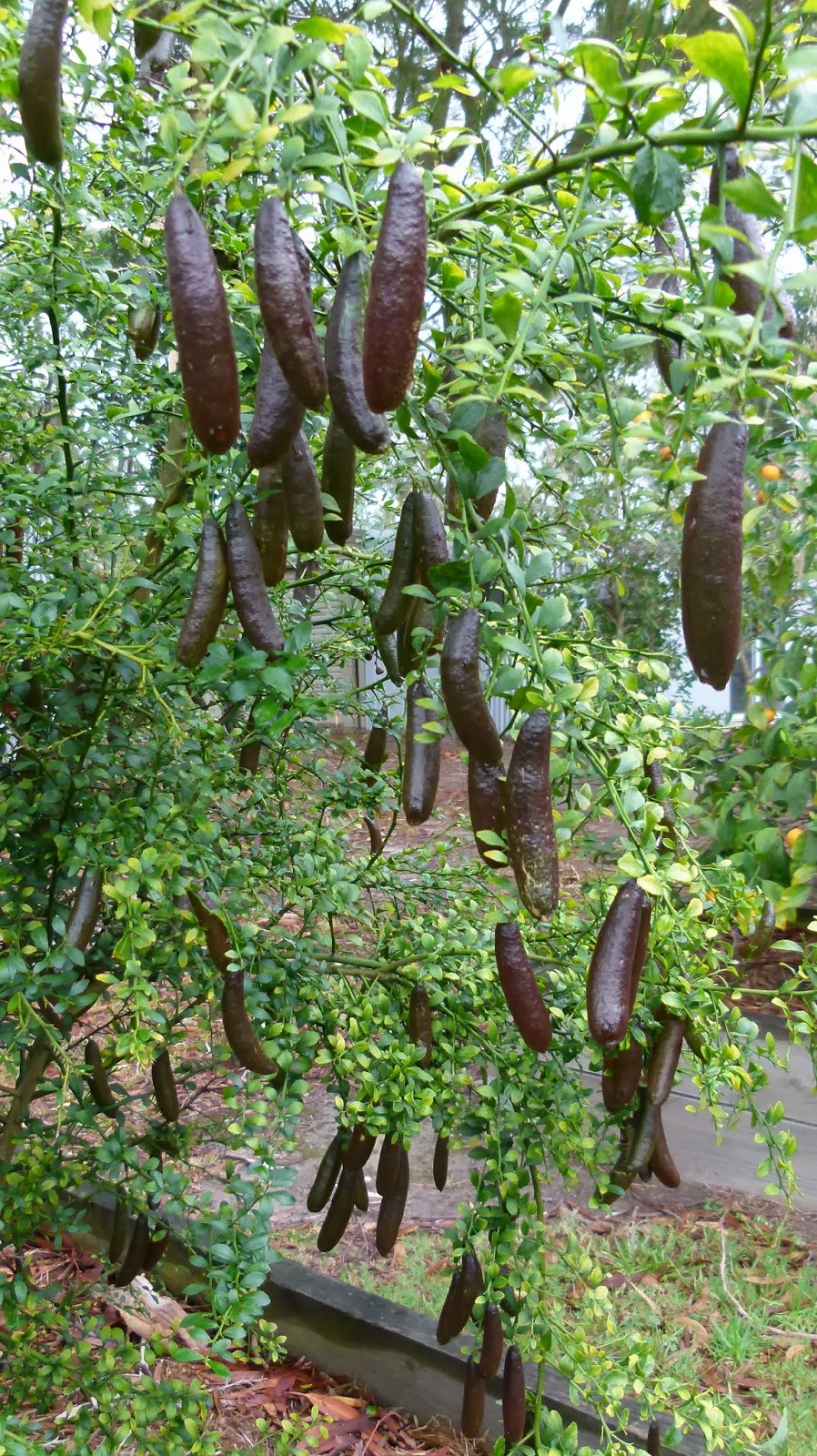
Finger Limes A really great crop of finger limes this year. Have two varieties, one that has yellow /pale green juice vesicles and the skin turns very dark green, almost black, when ripe and the other has red vesicles and
the skin turns from green to almost black and finally to red when ripe. if the ripe fruit is left too long on the tree it will eventually split open exposing the flesh and then drop off the tree.
Pears
The pear also did very well this year, it is still fairly young and in the past has only had 3 or 4 fruit each year, but this year there were about twenty fruit, that I have just picked and put in storage and bring out enough to ripen as needed.
Breakfast, Lunch & Dinner
For breakfast I am having pears sprinkled with finger lime 'caviar', which really compliment each other. Am also using the lime vesicles on fish, on lamb chops, in salads as well as on and in desserts. Something that is really simple and extra wonderful is combining the vesicles with vanilla ice cream, the pop of the frozen globules and the flash of citrus is sensational.
A pear, rocket, macadamia nut, finger lime (all from the garden) salad, dressed with extra virgin olive oil and shaved Parmesan, is also something that is difficult to go past.
KarkallaThis indigenous plant commonly called 'pig-face', normally grows on sandy coastal areas and does OK in my garden but, understandably does not have the salty taste of the plants that grow near the sea. Being a low growing plant it also tends to get smothered by the wild excesses of the rocket, mustard greens , rapini, etc unless I am there to rescue it.
I use it fresh in salads and in sandwiches and with grilled meat, the Karkalla is quickly braised in a pan while the meat is resting.
Scarlet RunnerThis is a great bean as it flowers proflically making an attractive addition to the garden, crops well and will re-shoot the next year from a fairly large tuber / root after it dies down in winter.
The beans have a furry skin which does not affect the eating once they are cooked. These beans also have a reputation for being excellent for freezing, though I have always eaten all of my crop rather than freezing any excess.
I use the beans as per normal plus I delight in pasta with beans, tinned tuna, a touch of chilli, garlic, lemon or finger lime dressed with extra virgin olive oil.
Max Dingle 5 March 2014
http://www.maxdingleart.com/max-blog.html
Saturday, March 1, 2014
Purslane
| Purslane in my garden |
Healthy eating
The rain has revived the garden, and all the self sown plants are going crazy, rocket, mustard greens rapini and purslane to name the quick starters. Purslane is mostly in 'western' cultures looked at as a weed, as you could guess by one of its common names "pig-weed". However in Europe, Mexico and Asian countries it is grown as both vegetable and edible medicine and I have also seen a reference to Australian Aboriginal people making the seeds into seed-cakes.There are numerous species and it is easy to grow, in fact if you have it you certainly will not need to plant seeds. Purslane will grow in any soil, the current foraging movement in the cities find it growing in cracks in the pavement, but I like to have it in my garden beds - but it does need constant attention to stop it taking over the whole garden. If you have it in your garden then eat it, it one of the most healthy plants around having probably the highest Omega 3 contents of any plant, an essential fatty acid normally only found in quantity such as this in fish, as well as other fatty acids, antioxidants, vitamins A, C, E and some B plus minerals, magnesium, calcium, potassium and iron.
The whole plant can be eaten, stems, leaves, flowers, seeds but usually it is best as the plants get older just to pick the 3 to 5 cm. Eat as is, in salads or on sandwiches, use as you would spinach, use in stirfries, and is also good as a thickener in soups. One of my favourites is my version of a Weed Pie, use the recipe for a standard fetta and spinach pie but substitute Purslane, dandelion, wild rocket, mustard greens for the spinach.
Max Dingle 1 March 2014
http://www.maxdingleart.com/max-blog.html
Thursday, February 27, 2014
Food on the Road
Conference & Book Review
Railway Dining
A conference on
the history of dining on railways is to be held in Tours, France on 16 and 17
December 2014, papers will cover railways throughout the world. Ideal for anyone
who’s idea of heaven is sipping a fine red over a steak-frites and watching the
scenery whizz by.
Contact : jean-pierre.williot@univ-tours.fr
or laurent.tissot@unine.ch
or Michele Merger mi.merger@virgilio.it
A Fork in the Road : Tales of food, pleasure & discovery on the road
Editor James Oseland 2013 Lonely Planet ISBN 9781743219775 (Hbk)
Max Dingle 27 February 2014
Sunday, February 23, 2014
The Lamington Engima
The Lamington Enigma : A survey of the evidence
Maurice French
Tabletop Publishing 2013 280 pp ISBN 9780987432209
The lamington is of course an iconic cake in Australia, known through numerous school , girl guide and many other fund raising drives, as well as being a popular serving at morning and afternoon tea., and, lets face it, it is delicious, but where and who created or invented this cultural icon?
This book is an enjoyable romp through the history of this sweet, named for either Lord or Lady Lamington - he was Governor of Queensland, 1896 - 1901. French provides us with intimate stories of colonial life at the end of the 19th century with quotes from various named and unnamed sources such as 'Lord Lamington was a pompous ass, and no one would have named a cake after him.' , and of course Lamington was allegedly rather rude about the matter of the cake itself, describing them as 'those bloody poofy, woolly biscuits' .
This search for the creator of the lamington encompasses many trips through newspapers, cook books, family histories and interviews with surviving relatives of cooks, maids and governors. It also brings to light, in one of the meanders down a side track that Helena Rubinstein (of cosmetic fame) was either a maid or a governess in the Lamington household.
The conclusion you will need to read for yourself but the journey there is really great fun. I will give the last word in this short review to the author, who acknowledging that with this publication, many people will throw new light on the subject matter and no doubt a few will quibble with the assessment, 'To them all I say:"Let them eat lamingtons"'.
May be purchased from Tabletop Publishing, 60 Phillip St., Toowoomba, Qld 4350 AUD $39.95
or contact maurice.french@usq.edu.au
Max Dingle 23 February 2014
http://www.maxdingleart.com/max-blog.html
Thursday, February 20, 2014
2010 Basket Press Shiraz
New release from Salet Basket Press Wines
2010 Basket Press Shiraz
This is a big wine, big in flavour, big in intensity and big in colour, winemaker, Michael Salecich, normally produces big wines but this 2010 made in the Shoalhaven from hand picked Adelaide Hills grapes is bigger than most.
Produced with the usual hand made finesse and given 45 months in American and French oak hogshead barrels before bottling in December 2013, the wine is a rich and intense deep purple.
The bouquet displays an intensity of ripe berry fruits, black current, blackberry and a slight mulberry note. In the mouth it is initially a bit unsettled from the recent bottling, there is a firm finish and strong kick from a high alcohol of 16% but with some air it settles down to very pleasant drinking especially if you , as I do, like what I call old fashioned Australian reds, those great reds we had in the 1950's, 60's and 70's big, bold and beautiful. Mellow but mouth filling with a great balance between fruit and the oak.
Get some of this wine and let it settle in your cellar for three months to get the best from early drinking but do not be in a hurry to scoff the lot, this wine will only improve over time and my guess is it will peak in about 20 to 25 years and still be a great drop for years after that. This wine is a bargain at the price it sells for, certainly not priced at the bottom end of the market but unique hand made quality products never are. See: www.salet.com.au
Max Dingle 13 February 2014
http://www.maxdingleart.com/max-blog.html
Sunday, February 9, 2014
Genetically modified crops
Genetically Modified crops
Here is a message via Slow Food about a court case coming up in West Australian tomorrow 10 February 2014.
If you are against GM crops there are ways suggested in Slow Foods message to show support.
Max Dingle 9 February 2014
www.maxdingleart.com
“Carlo Petrini, President of Slow Food International, said "The case of Steve Marsh offers concrete proof of the fact that GMOs pose a threat not only to our health and the environment, but also to a fundamental right, the right to food sovereignty. It is unacceptable that an Australian organic farmer should lose certification for approximately 70% of his land after it was contaminated by Monsanto GM canola from a nearby farm. GMOs are depriving farmers and consumers of their fundamental right to choose. The former cannot choose what they grow, while the latter often cannot choose what they eat. For this reason, we support Steve Marsh in his battle, and we invite everyone to participate in the global Twitter storm using the hashtag #IamSteveMarsh. Even though this is just the story of one Australian farmer, the way in which it plays out in the courts on February 10 could have global implications."
Slow Food is against the commercial planting of genetically modified (GM) crops. We promote GM free food and animal feed and we are active in a global campaign against all genetically modified organisms (GMOs)! We believe that we need to protect the future of food and farming that will benefit people and the planet and not the pockets of big business.
Steve Marsh is a farmer from Kojonup, south of Perth, who lost his organic certification when Monsanto’s GM canola blew onto his farm from a neighbouring property in 2010. Steve lost most of his income and has struggled for the past three years trying to make ends meet while working to decontaminate his land and get his organic certification back. As Monsanto has a no liability agreement with GM farmers it prevents them from being sued. Steve’s only choice was to take his neighbour to court for compensation of loss and damages. Steve’s neighbour is well supported and well funded by a pro-GM organisation.
This landmark case against a farmer's right to grow clean food will start on February 10th in the Western Australian Supreme court. See some of Steve's story on YouTube (http://www.youtube.com/watch?v=YpQHuUTfRro&feature=youtu.be).
Now is the time to ask you to act. I am calling you to take action to support Slow Food Perth , safe food foundation and Steve Marsh in his court case to fight GMO contamination on his farm and for his right to produce good, clean and fair food.
What can you do?
Distribute this information. Please send the information to your local journalists so that they are aware of the case with a clear message that Slow Food is against GMO’s. Use social media to inform your members and friends or simply pass on this email to work colleagues, friends and any interested parties.
Support Steve financially. Safe Food Foundation (http://safefoodfoundation.org) is one of the major supporters of Steve's right to farm GM-free food. If you are able to help, please support Steve financially by going to http://safefoodfoundation.org/helpthisfarmer and donating (even the smallest amount can help).
Show support in other ways. If you cannot help financially, please feel free to send messages of support to Steve via www.facebook.com/HelpThisFarmer. Your comments are vital so that the collective voice of slow food opposition to GMOs is heard in all parts of Australia and the world.
Keep up to date with the case. For the first time in WA courts, journalists can tweet live during court cases. Follow journalists on Twitter who are covering this case and let others know which Twitter feeds to follow.
Slow Food's opposition to GMOs can be found at: http://www.slowfood.com/international/22/gmos.
Friday, February 7, 2014
International Food Studies Conference
This one is a little late but you could still get there if you are quick !!!
17 to 19 February 2014
Food Studies: a Multidisciplinary Menu
This conference aims to bring together scholars who apply diverse methods and approaches, generating exciting interdisciplinary dialogues that respond to a range of core questions central to Food Studies scholarship. Contributions have been made in response to the following questions: what has been the impact thus far of Food Studies, both on other research fields and on our understandings of our past and present food habits and cultures? What have been the field's main achievements and unfulfilled promises? What are the core issues related to eating and drinking in contemporary society, and what can we learn from the past? What are the most fruitful and productive questions and methods to pursue in future food studies research?
Topics include:
Food / gastronomic heritage
Diet and culture
Food studies as methods
Drink and drinking
Contemporary debates on food and consumption
Food and travel
Migration
Globalization
See: https://www.adelaide.edu.au/food-studies/conference/
Or for more information email : foodstudiesconf@Adelaide.edu.au
Max Dingle 7 February 2014
www.maxdingleart.com
Wednesday, February 5, 2014
Call for foodies to Popular culture conference
Popcaanz 18 - 20 June 2014
Popular Culture Association of Australia and New Zealand
A conference to be held in Hobart this year is calling for foodies to consider submitting an abstract for a food and culture related paper.The call for papers is on this link to the conference website.
http://popcaanz.com/conference-information-2014/
This year’s conference will coincide with Dark Mofo, (click for link)
A public event of music, performances, light shows, and food including:
Winterfeast
Max Dingle 5 February 2014
www.maxdingleart.com
Tuesday, February 4, 2014
Raw Cabbage
Raw Cabbage
I must admit that I am not overly fond of coleslaw, that mix of raw cabbage, raw onion and carrot plus mayonnaise. I do eat it but with not much pleasure, however having a an excess of red cabbages in the garden I have had to search out and have found a really good raw cabbage salad. I suspect that the 12 to 24 hours in the marinade tends to pickle the ingredients and gets rid of the repeating taste of raw onion and cabbage. (It will probably work for green cabbage as well, though I have not tried it.)
Red Cabbage Salad
1whole
red cabbage finely sliced
1
to 2 eschallot or small red onion finely sliced
½
cup sherry vinegar
½
cup olive oil
½
cup sugar
4
tablespoons soya sauce (light or dark - your preference)
Mix
all together and leave in marinade for 12 to 24 hours
Before
serving add dried cranberries and dry roasted cashew nuts - quantities of each
to your taste.
Toss
and serve
Max Dingle 4 February 2014
Thursday, January 30, 2014
The Table Comes First - book review
The Table comes First : Family, France and the meaning of Food by Adam Gopnik 2011
Vintage Books ISBN 978-0-307-47696-8
A really great read that searches for a truth in the meanings we give to food, a search through history, philosophy, literature and culture of our food obsessed world.
Max Dingle 30 January 2014
Here is an extract:
Cooking is the faith that raw ingredients can be conjured into a nightly miracle.
The oldest of all recorded stories is the story of Enkidu from the epic of Gilgamesh, and it is a story of the divine power of food, sex and wine to make human.
Enkidu, wild and uncivilized is saved by a prostitute.
"Nothing does Enkidu know of eating bread,
and to drink strong drink he has not been taught." she says
'The whore opened her mouth , saying to Enkidu,
"Eat the bread, O Enkidu, it is the staff of life;
drink the strong drink,
it is the custom of the land."
Enkidu ate bread until he was sated: Of the strong drink he drank seven goblets. His soul was free and happy, his heart rejoiced, and his face shone.....
he anointed himself with oil and at that moment became human.'
In honour of Enkidu and the whore:
The four essential savoury secrets : anchovies, bacon, cinnamon, saffron
The five humble helpers: frozen peas, canned beans, corn syrup, gelatin, cornflour
The three miraculous drugs: sugar, caffeine, spirits
The three basic principles:
1. The rule of triple action : take something to eat, do something to it, do something else to it.
But for goodness sake do not do something else after that, or if you do, it had better be really worth doing.
2. The rule of three and four: almost anything ( salmon, chicken breasts, fish steaks, beef steaks, mushrooms, grilled bread) tastes best if it is sautéed for four hot minutes on one side and then three slightly cooler minutes on the other.
3. The truth of oven extremes: there is no golden mean behind the oven door - let your oven be very hot or rather cool, but never in between.
The truth of taste : taste is a fiction, shaped by a time. But the fiction is not the barrier to the feeling. It is what gives the feeling force. We make up our tastes as we make up our pesto, and it is the making-up that makes it matter.
Subscribe to:
Posts (Atom)
